
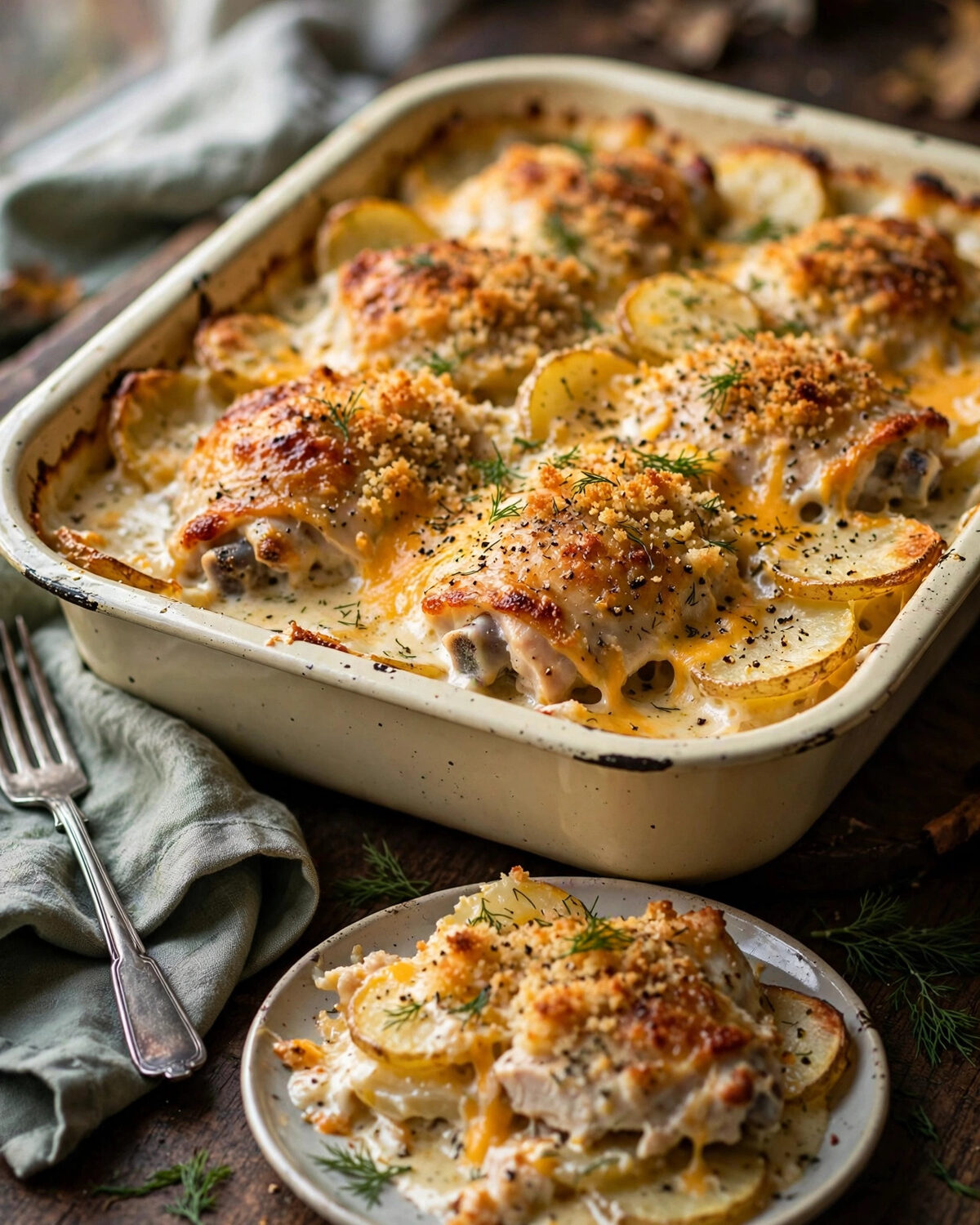
Most chicken and potato casseroles lean on two shortcuts: a packet of ranch seasoning and a can of cream of something soup. Both work, and both taste like the packet and the can. This ranch chicken and potato casserole takes the longer road by about twelve minutes and lands somewhere else entirely: a buttermilk cream sauce built from a roux, potatoes that go crisp at the edges instead of collapsing, and a brown butter crumb topping that shatters when the spoon goes in.
The method is mostly about water. Potatoes hold it, chicken releases it, and cream sauces break when they meet too much of it at once. Parboil the potatoes with a pinch of baking soda, crush them flat so the ragged surfaces can catch fat, and sear the thighs skin side down in a dry pan before anything liquid comes near them. That order removes the water problem and gives you a casserole with a crust instead of a puddle.
As a ranch chicken and potato casserole, it feeds six, it reheats without separating, and the crumb topping survives a night in the fridge, which makes it a reasonable thing to bake on Sunday and eat on Tuesday. If you keep the ranch blend in a jar, the real work drops to about twenty minutes.
Why This Ranch Chicken and Potato Casserole Works on a Weeknight
Three decisions do the heavy lifting here, and none of them is difficult. First, a homemade ranch blend made with buttermilk powder, so the seasoning tastes of dill and black pepper instead of salt and anti-caking agents. Second, Yukon Gold potatoes cut thick enough to hold their shape, parboiled briefly so the interiors are tender before the oven ever gets involved. Third, a roux based cream sauce rather than condensed soup, which means you control the salt and the sauce never tastes metallic.
The chicken is bone in, skin on thighs, and that is not an accident. Dark meat tolerates a fifty five minute bake without drying out, and the skin renders enough fat to brown the potatoes underneath it. Boneless breast will work, but it needs to go in later, and the texture of the finished dish changes from silky to something closer to sliced turkey.
One more thing worth saying: this is a casserole, not a diet dish. It uses butter twice, once in the sauce and once browned for the topping, plus whole milk and sharp cheddar. Cutting all of that back produces a watery bake that no one finishes, which is a worse outcome than a generous one.
Mix Your Own Ranch Seasoning With Buttermilk Powder
Store bought ranch packets are mostly salt, maltodextrin and dried buttermilk. Making the blend at home takes four minutes and gives you a seasoning that tastes green and herbal rather than dusty. Whisk together three tablespoons of buttermilk powder, one tablespoon each of dried dill and dried chives, two teaspoons of dried parsley, two teaspoons of onion powder, one teaspoon of garlic powder, one teaspoon of coarse black pepper and half a teaspoon of fine salt.
Buttermilk powder is the ingredient that makes it work. It carries the acidity and the cultured dairy flavor that ranch is built on, and it also helps thicken the sauce slightly as it hydrates. Look for it in the baking aisle rather than the dairy case, and keep the jar in the fridge once it is open, because it clumps in a warm cupboard.
Make a triple batch. The blend keeps for three months, and it is the difference between a fifteen minute dinner and a forty minute one on a night when you have already given up. Use the extra on roasted potatoes, popcorn, cucumber slices or the whipped cottage cheese ranch dip, which uses the same flavor profile with a fraction of the fat.
Parboil the Potatoes With a Pinch of Baking Soda
Cut two pounds of Yukon Gold potatoes into one inch thick rounds and put them in cold salted water with a quarter teaspoon of baking soda. Bring them to a boil and cook for eight minutes, until a knife slides in with slight resistance. The baking soda raises the pH of the water, which speeds up pectin breakdown on the surface of the potato and leaves it rougher, and rough surfaces are where browning happens.
Drain them well and let them sit in the colander for five minutes so the steam escapes. Then press each round flat with the bottom of a glass until it splits at the edges. Do not mash them, and do not press them into paste. You want cracked, uneven discs roughly half an inch thick. Penn State Extension covers potato types and how starch levels change with cooking, and the short version is that waxy and all purpose potatoes hold their shape while russets fall apart.
Skin on is the right call for a bake like this. Potatoes USA lists about 110 calories for a medium skin on potato with roughly 620 milligrams of potassium, and most of the fiber sits in the skin, which also gives the crushed rounds a little structure to grip.
Sear the Thighs Skin Side Down for Fond
Pat six bone in skin on chicken thighs completely dry and season them with salt and pepper on both sides. Put them skin side down in a cold, dry twelve inch cast iron skillet and set it over medium heat. Leave them alone for nine to eleven minutes. The fat renders slowly, the skin turns deep gold, and the bottom of the pan collects the browned protein that will flavor the sauce.
Flip the thighs and cook two minutes more, then move them to a plate. They are not cooked through yet and should not be. Pour off all but two tablespoons of the rendered fat and save the rest in a jar, because it is better than butter for roasting vegetables later in the week.
Do not wipe the pan. The fond is the point. When the roux goes in, it will scrape that layer up and dissolve it into the sauce, which is where the roasted chicken flavor in this casserole actually comes from.
Build the Sauce With a Roux, Not a Can
Melt three tablespoons of butter in the same skillet over medium heat, add three tablespoons of flour and whisk constantly for two minutes, until the mixture smells like toasted bread and stops foaming. Pour in two and a half cups of whole milk in a slow stream, whisking the whole way, then add one cup of chicken stock and two tablespoons of the ranch blend.
Simmer for five minutes, whisking, until the sauce coats the back of a spoon. Take it off the heat and stir in six ounces of grated sharp cheddar and half a cup of sour cream. Taste it. If it tastes flat, it needs salt. If it tastes salty, it needs a squeeze of lemon rather than more dairy.
For a ranch chicken and potato casserole the sauce should be slightly thicker than you want it in the finished dish, because the potatoes and the chicken will release liquid in the oven. This is the single most common failure point in a chicken potato casserole, and it is entirely preventable. Warm milk also helps: cold milk hitting a hot roux seizes, and seized roux is hard to rescue.
Brown Butter Is the Secret in the Crumb Topping
Melt four tablespoons of butter in a small pan over medium heat and keep swirling until the milk solids turn the color of hazelnut and the kitchen smells nutty, about four minutes. Pour it immediately over two cups of coarse fresh breadcrumbs, a third of a cup of grated parmesan, two tablespoons of the ranch blend and a handful of chopped fresh dill.
Toss with a fork until the crumbs are evenly coated and clumpy. Brown butter behaves differently from melted butter here: the toasted solids add a flavor that reads as depth rather than richness, so the topping tastes savory instead of greasy. Add a small handful of crushed kettle chips if you want more crunch, and do not add them earlier or they go soft.
Make the crumb in a bowl wide enough to toss in, not in the pan. The pan stays hot and will keep cooking the crumbs into dark little pellets while you are still mixing.
Layer the Ranch Chicken and Potato Casserole in the Right Order
Spread half the sauce across the bottom of the dish for the ranch chicken and potato casserole, of a nine by thirteen inch baking dish, then arrange the crushed potatoes in a single layer, then the sliced chicken thighs, then the remaining sauce. Press everything down gently with a spatula so the sauce comes up between the pieces. Scatter the crumb topping over the top in an even layer, leaving a bare half inch at the edges of the dish.
The order matters more than it looks. Sauce on the bottom insulates the potatoes from direct heat so they soften before they scorch. Chicken in the middle stays moist because it is surrounded by liquid on both sides. Crumbs on top stay crisp because nothing wet is above them.
Use a dish with at least three inches of depth. A shallow pan means the sauce bubbles over the rim onto the oven floor, and burnt dairy is a smell that stays in a kitchen for a day.
Bake the Ranch Chicken and Potato Casserole Covered, Then Uncovered
Cover the ranch chicken and potato casserole tightly with foil and bake at 400 F for twenty five minutes. That stage is about heat penetration: the potatoes finish cooking, the chicken reaches temperature and the sauce settles into the gaps. Then remove the foil and bake another twelve to fifteen minutes, until the crumb is deep gold and the sauce bubbles at the edges.
If the topping browns before the center is hot, lay a sheet of foil loosely over the top rather than lowering the oven. Lowering the temperature stalls the whole bake and gives you an underdone middle with an already crisp top.
Rest the casserole for ten minutes before serving. It looks like an unnecessary step and it is not: the sauce thickens as it cools a few degrees, and portions hold together instead of sliding into a heap on the plate.
How to Tell When It Is Done
To tell when this ranch chicken and potato casserole is done, an instant read thermometer in the thickest part of a thigh, away from the bone, should read at least 175 F. Dark meat is more forgiving than breast and is genuinely better at that temperature, because the connective tissue has broken down and the muscle has not yet dried. A knife slid into a potato should meet no resistance at all.
Look at the sauce as well. It should bubble slowly and look glossy, not flat and still. If the surface is dull and the crumbs are pale, the dish needs more time uncovered rather than more heat.
Make Ahead, Storage and Reheating
Assemble the ranch chicken and potato casserole up to a day ahead, cover it and refrigerate. Add ten minutes to the covered bake and leave the crumb off until it goes into the oven, because a buttered crumb sitting overnight on a wet surface turns soft. The ranch blend and the sauce can both be made three days in advance, which splits the work into two short sessions.
Leftovers of the ranch chicken and potato casserole keep four days in a sealed container. Reheat at 350 F covered for fifteen minutes, then uncovered for five to restore the top. Microwaving works but the potatoes go floury, so the oven is worth the extra time. Do not freeze the assembled dish: the sauce separates and the potatoes turn grainy on thaw.
What to Serve With Ranch Chicken and Potato Casserole
The richness in this ranch chicken and potato casserole needs acid, and a sharp salad is the right counterweight: arugula with lemon, thin sliced red onion and a mustard vinaigrette. Steamed green beans with brown butter and almonds work just as well and need eight minutes. If you want another starch, you have misunderstood the assignment, since the potatoes are already in the dish.
For a smaller crowd, halve everything and use an eight inch square dish, keeping the bake times the same. For a bigger one, make two dishes rather than one deep one, because a deep casserole cooks unevenly and the center never catches up to the edges. If you like the one pan approach as much as I do, this creamy garlic butter chicken scratches a similar itch in half the time.
Frequently Asked Questions
Can I use frozen potatoes instead of fresh
Yes, with a texture trade. Frozen diced potatoes or hash browns carry a lot of water and no skin, so thaw them completely, squeeze them in a clean towel until they stop dripping, and skip the parboil. The finished casserole will be softer and less crisp at the edges, and you should reduce the stock by a quarter cup to compensate. Fresh Yukon Golds remain the better choice if you have the ten extra minutes.
Why did my casserole turn out watery
Almost always one of three reasons. The potatoes went in wet, the sauce was too thin to begin with, or the dish was covered for too long. Drain the potatoes properly and let them steam dry, cook the roux based sauce until it coats a spoon, and uncover the dish for the last fifteen minutes so the extra liquid can reduce. Resting for ten minutes after baking also tightens the sauce considerably.
Can I make this ranch chicken and potato casserole dairy free
Not with a straight swap. The sauce depends on whole milk, cheddar and sour cream, and the topping depends on browned butter, so a dairy free version is a different recipe rather than a substitution. If you want to try it, use a roux with olive oil, unsweetened oat milk, a dairy free cheddar and a tablespoon of nutritional yeast for savoriness, and accept that the topping will taste toasted rather than nutty. For a naturally dairy free dinner instead, this slow cooker chicken and dumplings recipe is easier to adapt.
Can I use boneless chicken breasts
You can, but add them later. Sear them quickly, then nestle them into the sauce only for the final fifteen uncovered minutes, since a breast goes from tender to chalky in about six minutes at 400 F. Check for 160 F and pull the dish out early if needed. Thighs are the better partner for a fifty five minute bake, and the price difference usually favors them anyway.