
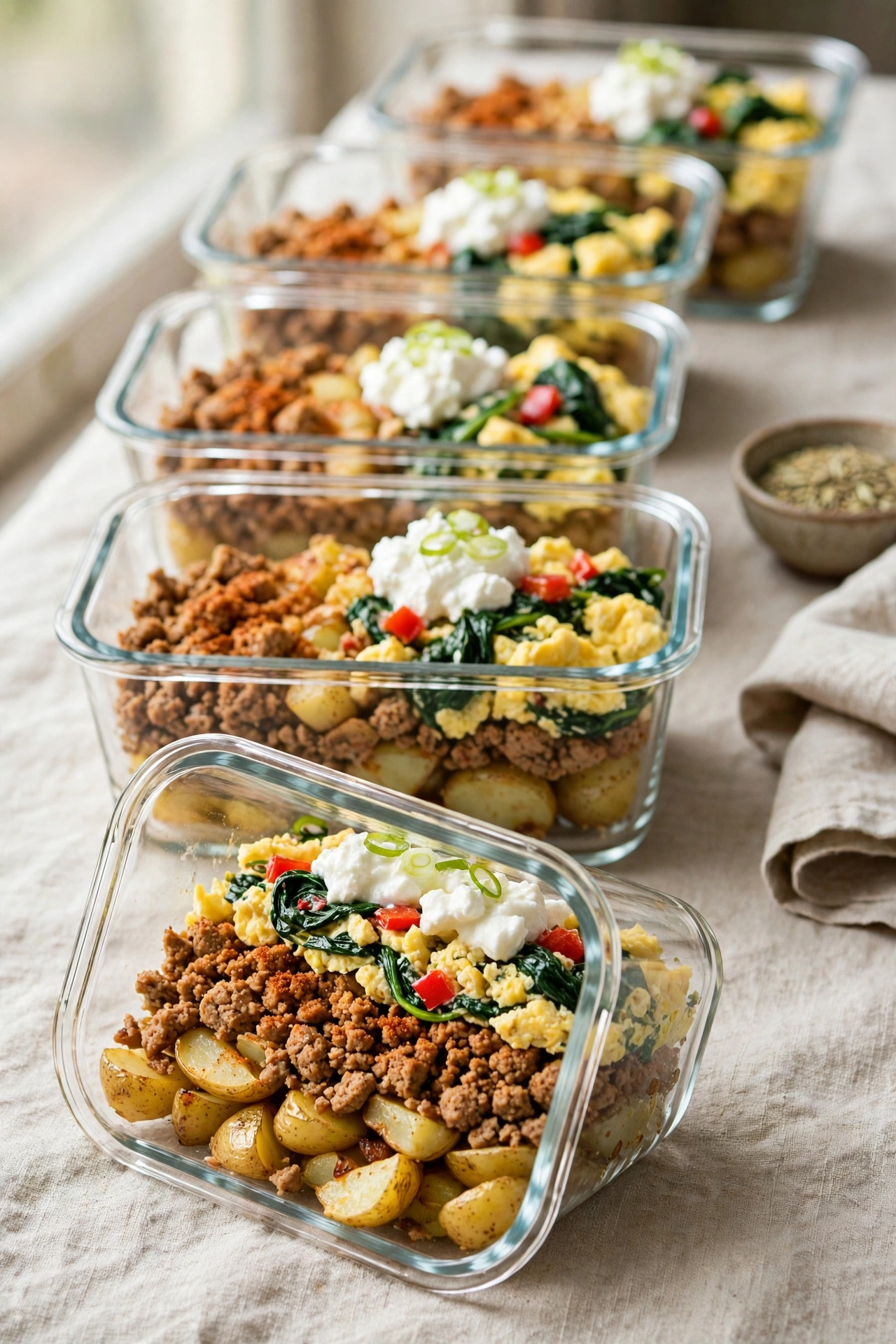
This high protein breakfast meal prep is built for the five mornings a week when you have eleven minutes, one microwave, and no interest in cooking. Five containers go into the fridge on Sunday, each holding roasted potatoes, browned turkey sausage, soft scrambled eggs and a spoonful of cottage cheese, and each one lands at 37 grams of protein for about 420 calories.
The version that fails is usually built like a casserole: everything baked in one dish, portioned into bricks, and reheated into steam. A high protein breakfast meal prep works better when the components stay separate until the fork, so the potatoes keep their crust, the sausage keeps its browning, and the eggs stay soft. Same four ingredients in the same container, cooked in three pans and stacked in a deliberate order.
What follows is the exact method for this high protein breakfast meal prep: the protein math, the order of construction, and the two mistakes that turn a good week of breakfasts into something you avoid by Wednesday. It takes about 45 minutes once and covers Monday through Friday.
Why This High Protein Breakfast Meal Prep Holds Up All Week
Three decisions carry this high protein breakfast meal prep. Fat is used twice, once to roast the potatoes and once to brown the turkey, so nothing tastes steamed or boiled. Salt goes in at every stage instead of at the end, which is the difference between seasoned food and salty food. And the eggs come off the heat while they still look slightly underdone, because they keep cooking from residual heat in the container.
There is a fourth rule, and it is the one people skip. Nothing wet goes into the container as a sauce. The cottage cheese sits on the eggs as a single dollop instead of being stirred through, so it cannot thin out by Thursday. If you want a high protein breakfast meal prep that still tastes good on the last morning, that rule matters more than any ingredient on the list.
The Protein Math Behind Each Container
A high protein breakfast meal prep only earns the name if the numbers survive portioning. This one starts with 450 grams of 93 percent lean ground turkey, five whole eggs, ten egg whites, 240 grams of low fat cottage cheese, 450 grams of baby gold potatoes and a tablespoon of olive oil, then divides into five equal containers.
- Ground turkey, about 90 grams cooked per container: 18 grams of protein
- One whole egg plus two egg whites per container: 13 grams of protein
- Cottage cheese, 48 grams per container: 5 grams of protein
- Potatoes, peppers and spinach: about 1 gram of protein
That is 37 grams of protein and roughly 420 calories per container, with 20 grams of carbohydrate and 17 grams of fat. Cleveland Clinic’s breakdown of daily protein needs puts most adults between 1.2 and 1.6 grams per kilogram of body weight, and research on protein distribution across meals points to about 30 grams per meal as a practical target. One container clears both numbers with no protein powder involved.
Cook the Potatoes First, and Crush Them
Halve 450 grams of small gold potatoes and put them in a pot of cold water with half a teaspoon of baking soda and a generous pinch of salt. Bring to a boil and cook for eight minutes, until a knife slides in with slight resistance. For a high protein breakfast meal prep the potatoes are the one component that has to stay crisp, so drain well and leave them in the colander for two minutes so the surface dries.
Then crush each potato with the flat of your hand or the bottom of a glass until it splits but still holds together. The ragged edges are the point, because they catch oil and go crisp in a way a smooth potato never will. Toss with a tablespoon of olive oil, a quarter teaspoon of salt and black pepper, spread on a sheet pan with space between them, and roast at 425 F for 22 to 25 minutes. This is the step that makes a high protein breakfast meal prep feel like real food instead of diet food.
Brown the Turkey Until It Almost Catches
Put 450 grams of 93 percent lean ground turkey in a dry skillet over medium high heat with a teaspoon of crushed fennel seed, a teaspoon of smoked paprika, half a teaspoon of garlic powder, half a teaspoon of dried oregano and a quarter teaspoon of red pepper flakes. Do not add oil, and do not stir for the first three minutes.
That untouched surface is where the browning happens, and browning is most of the flavor in this high protein breakfast meal prep. Break the meat into crumbles only after it has color, then cook until no pink remains and the edges are dark, about seven minutes total. Taste it before it goes into the containers. If it tastes flat, it needs salt rather than more spice.
Scramble the Eggs Low and Slow, Then Pull Them Early
Whisk five whole eggs with ten egg whites, a quarter cup of whole milk and a quarter teaspoon of salt until completely uniform, with no ribbons of white left. Heat a teaspoon of olive oil in a nonstick skillet over low heat, pour in the eggs, and stir constantly with a rubber spatula, scraping the bottom and folding the curds over themselves.
Take the pan off the heat while the eggs are still glossy and slightly loose, about four minutes. They will look underdone compared with scrambled eggs you would eat right away, which is exactly right for a high protein breakfast meal prep, because they finish cooking when the container is reheated. Fold in two cups of chopped baby spinach and one diced red bell pepper off the heat and let the residual warmth wilt them.
Build the Containers in This Order
Use five containers of the same volume for your high protein breakfast meal prep, about 700 milliliters each, so the portions stay honest. Potatoes go in first and stay at one end. Turkey goes next, packed against the opposite wall. Eggs fill the middle. A 48 gram scoop of cottage cheese sits on top of the eggs, off center, and sliced scallions go over everything.
Keeping the components in contact with the container rather than mixed together is what makes day four work. When you reheat, the potatoes crisp against the hot base, the eggs warm through without steaming in sauce, and the cottage cheese stays cold and creamy because you can lift it out before the microwave runs.
Cool Completely Before the Lids Go On
This is the step that decides whether your high protein breakfast meal prep survives to Friday. Spread the cooked components on a sheet pan for fifteen minutes before they go into the containers, or leave the filled containers open on the counter for the same time, then lid them and refrigerate.
Trapping heat under a lid creates condensation, and condensation is what makes roasted potatoes soggy and turns the surface of scrambled eggs gray. Food safety guidance is blunt about this too: cooked food should not sit between 40 F and 140 F for more than two hours, and shallow portions cool faster than one deep container.
Reheat Without Turning the Eggs to Rubber
To reheat a high protein breakfast meal prep, microwave at 50 percent power for 90 seconds, move the potatoes and turkey to the outside of the container, then finish on high for 30 to 45 seconds. Take the cottage cheese out first, or leave it in for only the final 20 seconds. The lower power setting matters more than total time, because it heats dense potato and turkey without overcooking the egg.
On a stovetop, warm the potatoes and turkey in a covered skillet with a tablespoon of water for four minutes, then add the eggs for sixty seconds. A toaster oven at 350 F takes about eight minutes and gives the best texture of the three, which is worth knowing if you are home on Friday and want the high protein breakfast meal prep to feel like a cooked breakfast again.
Three Variations on the Same High Protein Breakfast Meal Prep
The base adapts without breaking the protein target. Swap the turkey for 450 grams of chicken sausage and the numbers barely move. Skip the meat, add a second scoop of cottage cheese and half a cup of cooked lentils, and you land near 30 grams of protein while keeping the whole thing vegetarian.
For a variation that eats like a different breakfast, replace the potatoes with a cup of cooked quinoa and add a spoonful of whipped cottage cheese ranch dip on the side. If you want something sweet in the rotation, a batch of apple cider donut muffins freezes well next to the containers, though they are a carb side rather than a protein source.
Storage and Food Safety
Refrigerate the high protein breakfast meal prep containers for up to four days, which covers Monday through Thursday, and freeze any fifth container the night you make it. Frozen containers keep for two months, and they should thaw overnight in the fridge rather than on the counter.
Label each lid with the date, keep the containers at the back of the fridge where the temperature is most stable, and reheat only the portion you are eating. Reheating the same portion twice is the most common way a good high protein breakfast meal prep goes wrong at the end of the week.
What to Serve With It Without Losing the Protein
One container of this high protein breakfast meal prep is a full breakfast on its own at 37 grams of protein. If you want more volume, add half an avocado or a handful of cherry tomatoes, which bring fat and water without diluting the protein. A slice of sourdough is fine if you are not chasing a number.
If you are building a full day of high protein meals, pair this breakfast with a lunch built the same way. crispy air fryer chicken nuggets and garlic butter shrimp and quinoa bowls both portion and reheat well, so one Sunday session can cover two meals instead of one.
Frequently Asked Questions
Can I use carton egg whites instead of fresh egg whites
Yes, and it is the easier route for a high protein breakfast meal prep. Use three quarters of a cup of liquid egg whites in place of ten fresh whites, which is the same amount by volume. Carton whites are already pasteurized, so they cook slightly faster: pull the pan off the heat about thirty seconds earlier than you would with fresh whites. Check the label for added salt, and if yours has any, drop the quarter teaspoon of salt in the egg mixture to a pinch.
How many days does this high protein breakfast meal prep keep
Four days in the fridge, which is why the recipe makes five containers and one of them gets frozen. Cooked eggs and cooked poultry both follow the same four day guidance for leftovers, and the potatoes are the first thing to decline in texture. If you make this on Sunday, plan on Wednesday being the last refrigerated container and thaw the frozen one for Friday.
Can I freeze these breakfast containers
The eggs and turkey freeze well, the potatoes do not. Freeze the container without the potatoes and cook a fresh batch of crushed potatoes on the night you thaw it, or accept softer potatoes and reheat them in a skillet rather than a microwave. Cottage cheese should not be frozen at all, so add it fresh after thawing. Label the lid with the freeze date and use it within two months.
Do I have to use ground turkey, or can I use pork sausage
Pork breakfast sausage works and tastes richer, but it changes the math. Standard pork sausage runs about 100 calories and 5 grams of protein per 30 grams, against roughly 53 calories and 6 grams of protein for the same weight of 93 percent lean turkey, so the container lands nearer 480 calories and 30 grams of protein. If protein per calorie is the goal for your high protein breakfast meal prep, stay with turkey or use chicken sausage.