
Lazy chicken recipes are not a compromise. They are the ones you actually cook on a Tuesday, when the sink is full and breading, frying and washing three pans is a hard no. This one is a dump and bake chicken and stuffing casserole: raw chicken breasts go into the baking dish, a creamy sauce gets whisked straight in the pan, a box of stuffing goes on top, and the oven finishes the job in under an hour. No chopping, no browning, no searing, and one dish to wash at the end.
The reason most lazy chicken recipes come out dry on top and soggy underneath is almost never the shortcuts. It is the order. Chicken has to reach 165F. Stuffing needs a damp start and a hot oven. The sauce needs something to cling to. Put those three in the right sequence and five minutes of assembly beats forty minutes of production. What follows is the exact build, the temperatures that matter, and the two mistakes that flatten this kind of casserole almost every single time.
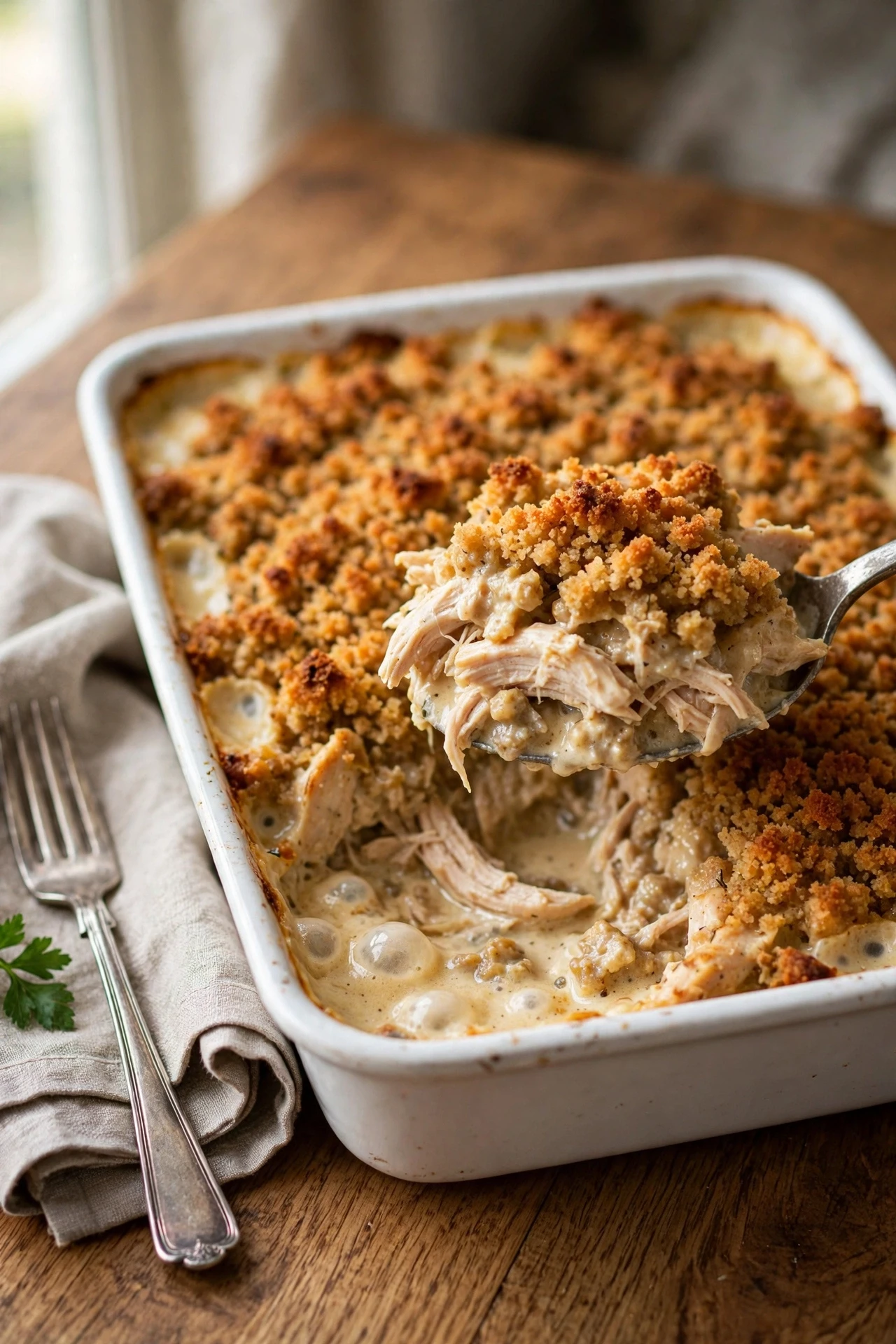
Why These Lazy Chicken Recipes Actually Work
Three things do the heavy lifting. First, the sauce is built in the baking dish, so the chicken sits in seasoned cream from the first minute instead of being salted at the end. Second, the foil cover turns the dish into a small steam oven, which cooks thick breasts through before the edges have a chance to dry. Third, the stuffing goes on only damp on purpose: it drinks the butter and the rising steam, so the top crisps while the underside stays soft.
That is the whole architecture of good lazy chicken recipes. Moisture underneath, crunch on top, and nothing that needs a skillet. You are not skipping steps that matter. You are skipping the steps that exist only to make a photo look busy.
What You Need for This Lazy Chicken Casserole
One 9×13 inch baking dish, one bowl for the stuffing, a whisk, and a thermometer. That is the full equipment list for these lazy chicken recipes. The thermometer is the only piece I will argue about, and I will get to why.
For the chicken and sauce
- 2 lb boneless, skinless chicken breasts (about 4 medium pieces)
- 1 can (10.5 oz) condensed cream of chicken soup
- 1/2 cup sour cream
- 1/2 cup whole milk
- 1 teaspoon garlic powder
- 1 teaspoon onion powder
- 1/2 teaspoon freshly ground black pepper
For the stuffing topping
- 1 box (6 oz) chicken flavored stuffing mix, seasoning packet included
- 1 1/2 cups hot water
- 1/2 cup (1 stick) unsalted butter, melted
- 2 tablespoons grated Parmesan, optional but excellent
Ingredient Notes and Simple Swaps
Breasts or thighs. Breasts are the leanest and the fastest, and they stay juicy under foil. Boneless thighs work just as well and forgive a longer bake, so add 8 to 10 minutes and check them at 165F the same way. What you actually want is even thickness. If your breasts are thick at one end, lay them flat side up and press the thick end down with your palm.
The soup is the sauce base. Condensed cream of chicken is the classic choice for lazy chicken recipes because it is already seasoned and already thick. Cream of mushroom or cream of celery works if that is what the shelf gives you. To skip the can entirely, whisk 1 cup of hot broth into 2 tablespoons of flour, simmer it two minutes until it thickens, then stir in the sour cream off the heat so it does not split.
Sour cream keeps it from tasting flat. It brings the acidity that canned soup does not have, and it is the difference between creamy and merely thick. Full fat yogurt works if you strain it first, otherwise the sauce turns grainy. Do not use fat free sour cream. It curdles at 400F and there is no way back.
Boxed stuffing, and I am not apologizing. These lazy chicken recipes exist for weeknights, and a box of stuffing is dry seasoned bread in a bag. If you want to build your own, use 6 cups of torn stale bread, 1 teaspoon of poultry seasoning, 1/2 teaspoon of salt, and the same hot water and melted butter.
Go light on the salt. The soup, the stuffing packet and the Parmesan are all salty already. Pepper and garlic powder go in. Salt usually does not need to.
How to Make Lazy Chicken Recipes, Step by Step
Total time is 55 minutes, and only 5 of those are you.
- Heat the oven to 400F (205C) and butter a 9×13 inch baking dish, corners included.
- Whisk the sauce in the dish. Combine the cream of chicken soup, sour cream, milk, garlic powder, onion powder and black pepper right in the baking dish. Mixing here instead of in a bowl is a big part of why these lazy chicken recipes are actually lazy.
- Pat the chicken dry with paper towels, trim any loose fat, and lay the pieces in the sauce in a single layer. Turn each one once so both sides get coated.
- Make the stuffing. Stir the stuffing mix and its seasoning packet with the hot water and melted butter for about 30 seconds, just until every cube is damp. Stop there. If it sits and soaks, you are making porridge.
- Spoon it over the chicken in an even layer and spread it gently with the back of the spoon. Do not stir it into the sauce. The line between stuffing and sauce is the entire point.
- Cover tightly with foil and bake 25 minutes. The trapped steam is what cooks the chicken evenly while the sauce stays loose underneath.
- Uncover, add the Parmesan, and bake another 20 to 25 minutes, until the top is deep golden brown and the sauce bubbles at the edges of the dish.
- Check the thickest piece of chicken with an instant read thermometer. It has to read 165F (74C). If it reads 155F, put the foil back on and give it 8 more minutes.
- Rest 5 minutes, then serve straight from the dish and spoon the sauce from the bottom over each portion.
The Rule That Keeps Stuffing From Turning to Mush
Do not pour the whole can of soup over the stuffing, and do not stir once it is layered. Stuffing is bread. Bread plus a fifty minute bath is a sponge. The layer order in these lazy chicken recipes is deliberate: chicken on the bottom, sauce around it, stuffing on top, and nothing mixed after assembly.
The second half of the rule is the foil. Steam has to stay in for the first 25 minutes and has to leave for the last 20. Skip the foil and the stuffing browns before the chicken is safe. Forget to take it off and you get a pale soft top that never crisps. Set a timer for both moments and the texture takes care of itself.
How to Know It Is Done: The 165F Test
Color is not a doneness test for chicken. A breast can look completely white and still be 150F in the middle, and food safety guidance is unambiguous: poultry needs to reach a minimum internal temperature of 165F measured with a food thermometer. Slide the probe into the thickest part, away from bone and away from the bottom of the dish. The USDA leftovers and food safety guidance is the reference I keep pinned in the kitchen.
Check the stuffing too. Because it is a moist dense bread mixture sitting against raw poultry, it is exactly the kind of environment bacteria enjoy, and the guidance for stuffing cooked in a casserole is the same 165F. One thermometer, two readings, thirty seconds. That is the least lazy part of these lazy chicken recipes and it is the one part I will not let you skip.
Make Ahead and Freezer Notes
You can build the sauce and trim the chicken up to a day ahead and keep them separately covered in the refrigerator. Do not mix the stuffing with water until the moment it goes on top, because wet stuffing held overnight collapses before it ever sees the oven.
To freeze any of these lazy chicken recipes, bake the casserole fully, cool it uncovered for 20 minutes, then wrap the dish and freeze up to 3 months. Thaw overnight in the refrigerator and reheat covered at 350F for 30 to 35 minutes, uncovering for the last 10. Reheating is the one place these lazy chicken recipes can go wrong, so add a splash of milk or broth before the foil goes back on.
How Long It Lasts in the Fridge
Cool leftovers within two hours of coming out of the oven, refrigerate them in shallow containers, and eat them within 3 to 4 days. Reheat to 165F. Those numbers come straight from USDA food safety guidance on leftovers, and they matter more here than in a plain roast because the sauce and the stuffing both hold moisture and hold heat.
What to Serve With Lazy Chicken Casserole
Keep the sides as lazy as the main dish, which is the entire promise of lazy chicken recipes.
- A bag of frozen green beans or broccoli, steamed while the casserole rests, or a bowl of one pot broccoli cheddar soup if you want two comfort dishes on the table
- Mashed potatoes, because the sauce is a gravy in disguise
- A crisp green salad with lemon and olive oil to cut the cream
- Buttered peas, ten minutes, straight from frozen
- Nothing at all, straight from the dish with a fork, which is the honest serving suggestion for lazy chicken recipes
Five More Lazy Chicken Recipes for Busy Nights
When this one is in rotation and you want variety without more work, these all follow the same dump and bake logic. If you want a skillet dinner instead, my one pan apple cider chicken thighs use the same no fuss approach.
- Honey mustard chicken and green beans. Whisk 1/4 cup honey, 3 tablespoons Dijon and 2 tablespoons melted butter in the dish, add chicken and a bag of frozen green beans, bake 35 minutes uncovered.
- Salsa chicken. A jar of salsa, chicken breasts, and a handful of shredded cheese added in the last 10 minutes. Shred it with two forks and pile it into tortillas.
- Ranch chicken and potato casserole. A packet of ranch seasoning, 2 lb of baby potatoes halved, chicken thighs on top, 45 minutes at 425F.
- Italian dressing chicken. One bottle of vinaigrette style dressing as both marinade and sauce, chicken, and cherry tomatoes, 40 minutes.
- Creamy mushroom chicken. The same base as this recipe with cream of mushroom soup and a cup of sliced mushrooms stirred in. No browning required.
All five are lazy chicken recipes in the same sense as this one: one dish, no searing, and a thermometer at the end.
Common Problems and How to Fix Them
The stuffing is soggy. The most common failure in lazy chicken recipes, and the easiest to fix. Too much liquid in the mix, the foil stayed on too long, or the sauce got stirred up into the bread. Use exactly 1 1/2 cups of hot water and remember that the sauce below is going to steam upward no matter what you do.
The top burned before the chicken was done. Your oven runs hot or the dish sat on the top rack. Move it to the middle rack, tent it loosely with foil, and check the chicken temperature every 5 minutes after the 40 minute mark.
The sauce broke and looks grainy. Almost always fat free sour cream, or cold dairy added to a hot dish. Use full fat sour cream at room temperature and whisk it into the soup before the dish goes anywhere near the oven.
The chicken came out dry. The breasts were thick and uneven, or the uncovered bake ran long. Pound the thick ends to an even inch and pull the dish the moment the center reads 165F.
Tips From My Kitchen
- Buy chicken that is all the same size. Uneven pieces are the single biggest reason lazy chicken recipes fail.
- Whisk the sauce with a fork if the sour cream is cold. A fork breaks up lumps faster than a whisk.
- Set the baking dish on a sheet pan before it goes in. It catches the bubble over and saves you scrubbing.
- Let the dish sit 5 minutes. The sauce tightens and stops running across the plate.
- If you like this style of cooking, my crockpot chicken and dumplings is the slow cooker version of the same idea. Cold leftovers are also excellent on a sandwich the next day, which is the real argument for making a 9×13 of these lazy chicken recipes instead of two portions.
None of those tips takes more than a minute, and each one is the difference between lazy chicken recipes that work and ones that end up in the sink.
How to Scale These Lazy Chicken Recipes for a Crowd
Double everything into two dishes rather than one deeper dish. Depth is the enemy here, because a deep casserole means the stuffing on top browns long before the chicken at the bottom is safe. Two 9×13 pans side by side on the middle rack behave exactly like one, and you can rotate them halfway through if your oven has hot spots.
For a smaller household, halve the recipe into an 8×8 dish and start checking the chicken at 35 minutes. The one thing you cannot halve is the thermometer reading, because a smaller pan with the same oven temperature still needs the same 165F.
Frequently Asked Questions About Lazy Chicken Recipes
Can I make these lazy chicken recipes with frozen chicken?
Do not put frozen chicken into this dish. Frozen breasts release water as they thaw, and that water goes straight into your stuffing and your sauce. Thaw the chicken in the refrigerator overnight, then pat it dry before it goes in the pan. The same rule applies to any of the lazy chicken recipes built on a creamy sauce, because a watery sauce is the first thing that goes wrong.
Do I have to use condensed soup?
No. Whisk 1 cup of hot chicken broth into 2 tablespoons of flour, simmer two minutes, then stir in 1/2 cup of sour cream off the heat. Add a pinch of garlic powder and a pinch of onion powder and it tastes closer to homemade than the can does, which surprises people who assume lazy chicken recipes mean a bland sauce. It adds one pan to the wash, which is the honest tradeoff for these lazy chicken recipes.
Can I add vegetables to this casserole?
Yes, but keep them dry and keep them under the stuffing. Two cups of frozen green beans or peas thawed and patted dry work well. Do not add mushrooms or zucchini raw on top, because they release water into the bread and you will get the soggy version of this dish instead of the crisp one.
Why is my casserole watery?
Three usual suspects: the chicken went in wet, frozen chicken was used, or the dish was covered for the full bake so nothing evaporated. Pat the chicken dry, thaw it properly, and always pull the foil for the last 20 minutes. If it is already watery, leave the dish uncovered at 425F for 8 to 10 minutes and the excess liquid will cook off.
One Last Thing Before You Cook
The whole appeal of lazy chicken recipes is that they ask almost nothing of you, and this one delivers on that promise without tasting like a shortcut. Five minutes of whisking and layering, fifty minutes of unattended oven time, one dish, and a dinner that holds up as leftovers. The only two things you cannot be lazy about are the foil timing and the thermometer, and both of those take less than a minute.