
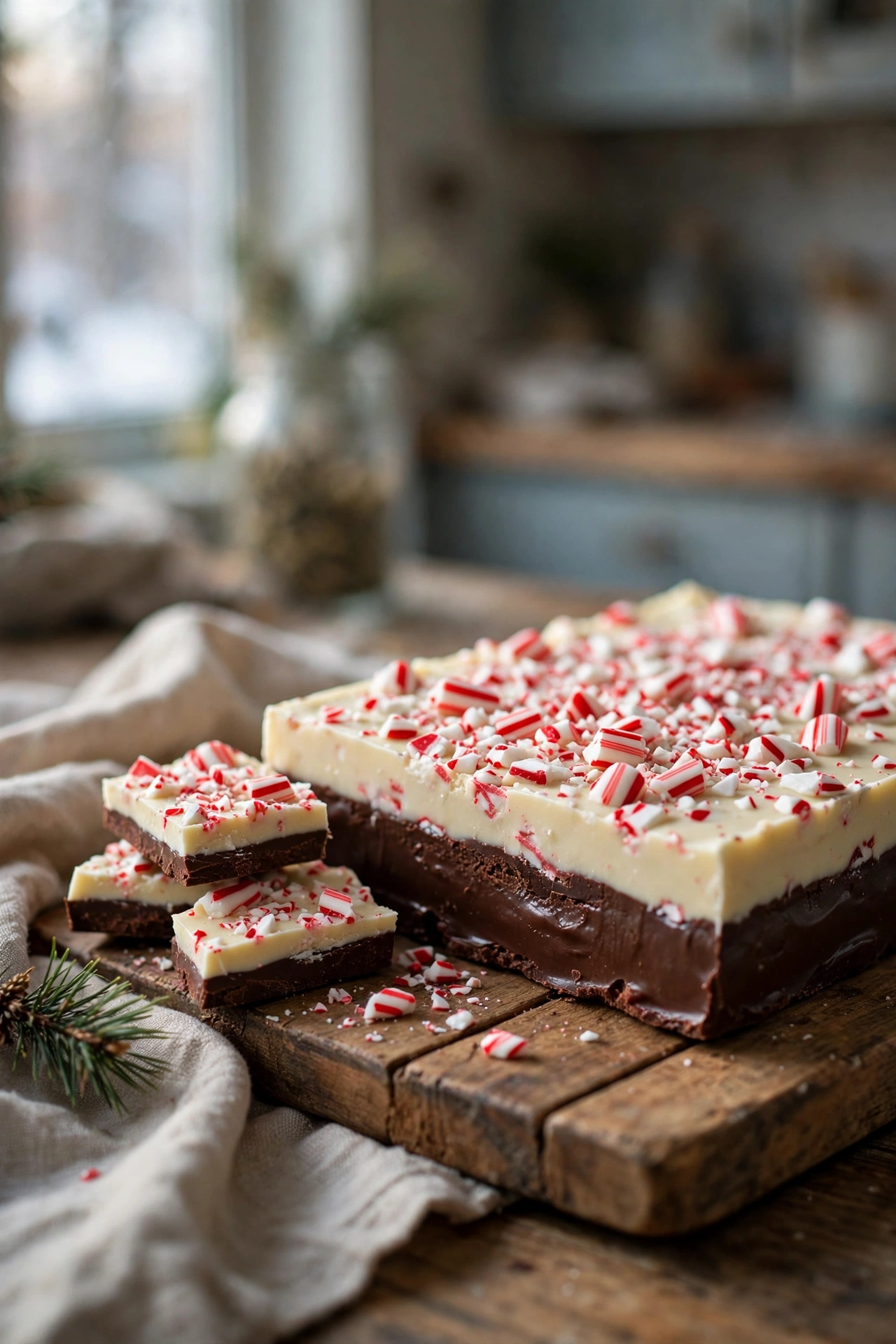
This peppermint bark recipe is the one thing I make every December that never survives past the second day. Two kinds of chocolate, a teaspoon of peppermint extract and a pile of crushed candy canes give you a crisp, snappy slab that looks like it came from a candy shop counter. There is no tempering, no candy thermometer and no special equipment: one bowl, one saucepan and a sheet pan lined with parchment. Twenty minutes of real work plus thirty minutes in the refrigerator and you have a stack of gifts for teachers, neighbours and the mail carrier.
The reason this peppermint bark recipe snaps instead of bending is boring and simple. You chill the dark layer until it is properly firm before the white chocolate goes anywhere near it, and you keep every bowl and spatula bone dry, because one drop of water turns melted chocolate into a grainy paste. Do those two things and the layers stay glued together, the surface stays glossy and the candy canes stay crunchy instead of slowly softening into the chocolate.
Why This Peppermint Bark Recipe Works
Most bark recipes start with a lecture about tempering, seeding and working on marble in a cold room. This peppermint bark recipe skips all of it. Chocolate chips and chopped bars are already stabilised with a little cocoa butter and lecithin, so they set firm and shiny when they cool slowly in the refrigerator. You are not trying to win a pastry exam, you are trying to make a Christmas treat that tastes good and does not smear all over the tin.
The second reason is the order of the layers. Dark chocolate goes down first because it is heavier, sets harder and gives the slab its snap. White chocolate goes on top because it is softer, sweeter and carries the peppermint better. If you flip them, the white layer becomes the base and the whole slab feels waxy when you bite it.
The third reason is the salt. A quarter teaspoon of fine sea salt over the top layer does something that sugar alone cannot do: it makes the peppermint taste brighter and stops the white chocolate from reading as pure sweetness. Skip it and the bark tastes flat, even with all that candy on top.
What You Need for Peppermint Bark
Everything here is supermarket stuff. The only ingredient worth a small upgrade is the chocolate itself, because cheap white chocolate with a lot of vegetable fat sets soft and never quite snaps.
- 12 ounces semisweet or dark chocolate, chopped or in chips. Chips melt faster and are more forgiving for a first attempt.
- 12 ounces white chocolate, chopped from a good bar if you can. Bars melt smoother than white chips, which often contain more stabilisers.
- 1 teaspoon peppermint extract, split between the two layers. Peppermint oil is much stronger, so use half if that is what you have.
- 6 standard candy canes, about three quarters of a cup once crushed. Starlight mints work too, though they are harder to crush.
- 1/4 teaspoon fine sea salt for the top, and a sheet pan lined with parchment paper.
That is the whole list. No corn syrup, no condensed milk, no shortening, nothing you will buy once and never touch again. If you want a slightly softer bite, replace two ounces of the dark chocolate with milk chocolate, but keep the rest of the peppermint bark recipe exactly the same.
How to Make Peppermint Bark Recipe: Step by Step
Step 1: Prep before you melt. Line a rimmed sheet pan with parchment so the paper overhangs two sides, which gives you handles later. Crush the candy canes now, not while the chocolate is sitting melted and cooling. Put them in a zip bag, wrap it in a tea towel and hit it with a rolling pin until you have a mix of fine dust and small shards. Sift out the powder if you want a cleaner look on top.
Step 2: Melt the dark chocolate. Put the dark chocolate in a heatproof bowl over a saucepan of barely simmering water, making sure the bowl does not touch the water. Stir with a dry spatula until about two thirds is melted, then pull the bowl off the heat and keep stirring until the last lumps disappear. Stir in half the peppermint extract.
Step 3: Spread and chill the base. Pour the dark chocolate onto the parchment and spread it into a rough 10 by 13 inch rectangle with an offset spatula. Do not fuss over the edges, you will trim them later. Tap the pan on the counter twice to pop air bubbles, then refrigerate for 15 minutes until the surface is matte and firm to the touch.
Step 4: Add the white layer. Melt the white chocolate the same way, gently, and stir in the rest of the peppermint extract. Let it cool for two minutes off the heat, then pour it over the chilled dark layer and spread it right to the edges. Work fairly quickly, because warm white chocolate will start to melt the dark base if you push it around.
Step 5: Top, set and break. Scatter the crushed candy canes over the white chocolate while it is still tacky, then sprinkle the sea salt. Press the candy down very lightly with the back of a spoon so it sinks in a millimetre. Refrigerate for 30 minutes, or until the slab is completely hard, then lift it out by the parchment and break it into rough pieces with your hands or cut it into squares with a warm knife.
That is the entire peppermint bark recipe from start to finish. If you can melt chocolate without burning it, you can make this on the first try.
Why This Peppermint Bark Recipe Skips Tempering
Tempering is the process of heating and cooling chocolate to specific temperatures so the cocoa butter crystals line up and the finished chocolate stays glossy and snaps at room temperature. It matters for dipped strawberries and moulded bars that sit out on a buffet for hours. For a home peppermint bark recipe that lives in the refrigerator and gets eaten within a week, it is extra work with almost no payoff.
What you lose by skipping tempering is long term shelf stability at warm room temperature. What you keep is your afternoon. If you do want tempered bark, melt two thirds of the dark chocolate to 115F, cool it to 90F by adding the remaining third, and spread it at that temperature. The steps stay the same, the clock just gets longer.
Why Does This Peppermint Bark Recipe Use Two Chocolates?
Because the contrast is the point. Dark chocolate brings bitterness and snap, white chocolate brings sweetness and a creamy base for the peppermint, and the two layers look like a candy cane when you cut through them. A single chocolate bark tastes fine, but it reads as plain chocolate with candy on top rather than as peppermint bark.
If you are feeding a crowd of kids, go 8 ounces dark and 16 ounces white, and the bark will be sweeter and softer. If you are making it for adults who like dark chocolate, push the ratio the other way and use 16 ounces dark with 8 ounces white. The peppermint bark recipe handles both ratios without any other change.
How Thick Should the Slab Be?
Aim for a total thickness of about a quarter inch, which means roughly an eighth of an inch per layer. Thicker than that and the bark is hard to bite and the layers tend to separate when you break it. Thinner and the white chocolate will not hold the candy canes.
The easiest way to hit the right thickness without measuring is to spread the dark chocolate over a 10 by 13 inch area and trust the numbers in this peppermint bark recipe. If your pan is bigger, the bark gets thinner, so keep the spread tight rather than pushing it to the corners.
How to Store Peppermint Bark So It Stays Crisp
Peppermint bark hates three things: warmth, moisture and air. Store it in a single layer in an airtight container lined with parchment, with more parchment between layers if you have to stack. Keep the container in the refrigerator for up to three weeks, or in a cool pantry for about ten days in winter.
Never store it next to the kettle or over the stove, and never in the freezer unless you plan to eat it frozen. Freezing makes the white chocolate sweat when it comes back to room temperature, and that condensation is exactly what turns the surface dull and sticky. If you do freeze it, thaw it inside the sealed container so the moisture lands on the plastic and not on the candy.
Make Ahead: Peppermint Bark Recipe for Gifts and Cookie Boxes
This is the most gift friendly thing on the site because it holds up for weeks and looks expensive. Make the full batch a week before you need it, break it into pieces, and layer it into tins with parchment. Add a small tag with the date so people know how fresh it is.
For cookie boxes, put peppermint bark in its own small bag rather than loose with the cookies. The peppermint scent is strong and will perfume everything else in the box, which is lovely for chocolate and strange for shortbread. If you are building a whole box, pair this peppermint bark recipe with soft gingerbread cookies and a slab of easy Christmas fudge and you have three textures and three colours without doubling your work.
Five Variations on This Peppermint Bark Recipe
Dark only: use 24 ounces of dark chocolate, skip the white layer, and press the candy canes straight into the top. Chill once instead of twice, so it comes together in about 25 minutes.
Espresso bark: add half a teaspoon of instant espresso powder to the dark chocolate while it melts. The coffee makes the peppermint taste sharper and cuts the sweetness of the white layer.
Salted caramel bark: drizzle two tablespoons of thick caramel sauce over the white layer before the candy canes go on. Use a caramel that is thick enough to hold a ribbon, not a thin ice cream topping.
Cookie crumb bark: swap half the candy canes for crushed chocolate sandwich cookies. You get the peppermint from the extract and a softer, crumblier texture on top.
Small batch: halve every ingredient in this peppermint bark recipe and set it in a loaf pan lined with parchment. It makes 12 pieces, which is the right amount for one household that cannot be trusted.
Mistakes That Ruin Peppermint Bark
Water in the bowl. The single biggest cause of seized chocolate. Dry every bowl, spatula and spoon before it touches chocolate, and never let steam drip from the saucepan lid into the bowl.
Melting on high heat. Chocolate does not need a rolling boil underneath it. Barely simmering water and patience, or short bursts in the microwave at half power, stirring between each one.
Pouring white chocolate onto soft dark chocolate. If the dark layer is still glossy and soft, the white layer will sink and the two will marble together. Wait for matte and firm, even if it takes an extra five minutes.
Adding the candy canes too early. They slide straight to the bottom if the white chocolate is hot. Wait until the surface looks like soft butter and holds a gentle indent.
Cutting it cold with a dull knife. Cold bark shatters, which is fine if you want rustic pieces and frustrating if you want squares. Let it sit at room temperature for five minutes and use a warm, sharp knife.
How to Serve This Peppermint Bark Recipe at a Party
Pile the pieces in a shallow bowl lined with parchment and keep the bowl away from the radiator. Peppermint bark is rich, so pair it with something plain: a pot of strong coffee, a glass of cold milk, or a plate of savoury Christmas appetizers to break up the sugar.
It also works as a finish for a big dinner instead of a plated dessert, especially after a heavy meal like cozy winter one pot dinners when nobody wants another course but everyone wants something sweet. Two pieces per person is plenty.
Nutrition, Allergens and Substitutions
One piece of this peppermint bark recipe, based on 24 pieces from the batch, has about 164 calories, 2 grams of protein, 17 grams of carbohydrate, 9 grams of fat and 15 grams of sugar. It is candy, not a health food, and it is meant to be eaten in small amounts.
The recipe contains milk and soy from the chocolate, and it is not dairy free. For a dairy free version, use a certified dairy free dark chocolate for the base and a dairy free white chocolate for the top, and check every label because white chocolate almost always contains milk powder. Candy canes are usually free of the top eight allergens, but always read the box. If you are cooking for someone with a serious allergy, the safest approach is to make a separate small batch with dedicated equipment.
Food safety basics matter less here than in a meat recipe, but the same rule applies: wash your hands before you start, keep the parchment clean, and store the finished bark cold. The USDA food safety basics are a good refresher, and the Harvard nutrition source on dark chocolate explains why the darker layers here carry more flavour for the same sugar.
Peppermint Bark Recipe: Frequently Asked Questions
Can I make this peppermint bark recipe without candy canes?
Yes. Crushed starlight mints, peppermint crunch sprinkles or even broken peppermint patties all work on top. You need about three quarters of a cup of something crunchy and minty. If you use soft mints, add them just before serving so they do not melt into the white chocolate.
Why did my peppermint bark turn out soft and bendy?
Almost always because the chocolate was cheap white chocolate with a high vegetable fat content, or because the slab never got cold enough. White chocolate needs at least 30 minutes in a refrigerator to set properly. If it is still soft after that, put it back for another 20 minutes and check that your refrigerator is actually below 40F.
How long does peppermint bark last?
Three weeks in an airtight container in the refrigerator, or about ten days in a cool pantry. After that the candy canes start to weep and the white chocolate takes on a stale flavour. Label the container with the date you made it, because peppermint bark all looks the same after a week.
Can I freeze this peppermint bark recipe?
You can, for up to two months, but thaw it inside the sealed container so the condensation forms on the plastic instead of the chocolate. The texture will be slightly softer after freezing, so it is better for baking into cookies or stirring into hot chocolate than for serving on a platter.